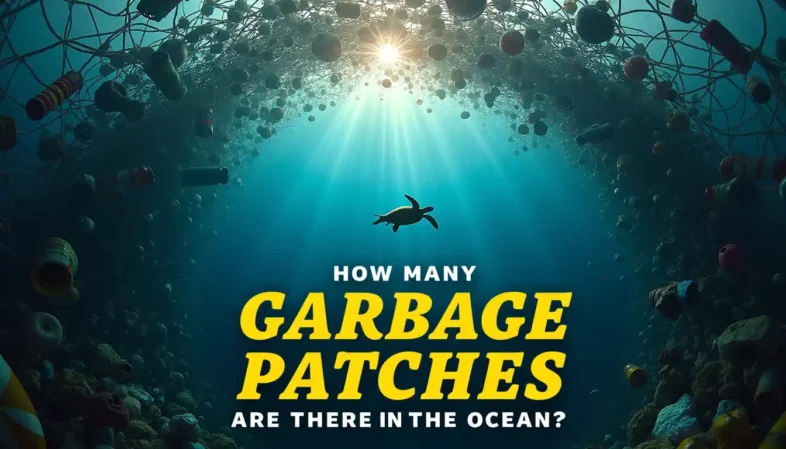
Garbage patches are large, swirling accumulation zones of marine debris, primarily microplastics, formed by rotating ocean currents known as gyres.
Quick Facts on Ocean Garbage Patches
- There are five ocean garbage patches in the world, and each is located in one of the five major ocean gyres.
- The Great Pacific Garbage Patch, which is located between Hawaii and California, is the largest and most studied of the five.
- Despite the name, these “patches” are not islands of trash floating on the ocean. Much of the debris is invisible microplastic that is suspended throughout the water column.
- Garbage patches are growing, and the extent of the damage they cause to marine ecosystems is still being discovered — including one alarming impact on the food chain that you should know about.
- Efforts are being made to clean up the garbage patches, but the removal of microplastics from the open ocean presents challenges that no technology has yet fully solved.
There are only five ocean garbage patches on the planet, and most people have only heard of one.
When discussing ocean plastic pollution, the Great Pacific Garbage Patch is often the centre of attention. This is understandable given its size, the fact that it has been well-studied, and its location between two heavily populated coastlines. However, this focus on the Pacific overlooks four other accumulation zones that are quietly gathering debris in the Atlantic and Indian Oceans. Organisations such as The Ocean Cleanup are working to map, study, and actively remove plastic from these patches, which is helping to raise public awareness about the extent of this crisis.
Grasping the big picture begins with understanding what these patches really are — and what they’re not.
Understanding the Five Ocean Garbage Patches
Five may not seem like a large number, but when it comes to garbage patches in the ocean, it’s a different story. Each of these patches represents a massive, ever-changing collection of marine debris, all driven by the powerful currents of the ocean. But these aren’t just random dumping grounds — they are the expected outcome of the way our ocean circulation system operates. Each major gyre, a large system of rotating ocean currents, works like a slow-moving whirlpool, gradually pulling floating debris towards its centre. Since there are five major gyres, there are, consequently, five garbage patches.
The truly worrying part is that the plastic doesn’t stay put. The debris is carried in and out of these zones by changing winds and currents, which makes the patches constantly changing, without clear borders, and incredibly difficult to measure. The five patches are not the same size or density, but all five are getting bigger.
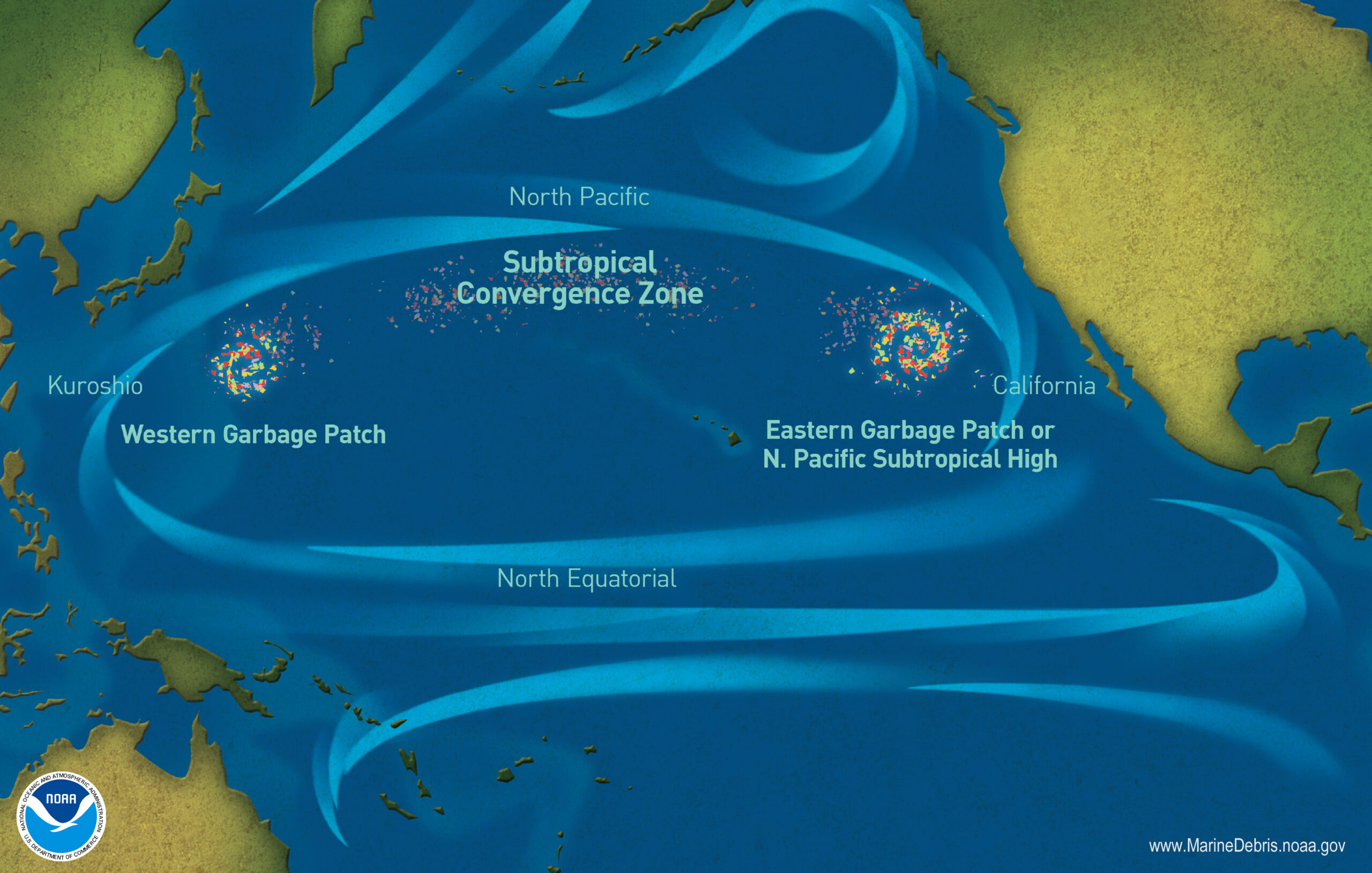
“What are garbage patches?” from oceanservice.noaa.gov and used with no modifications.
Understanding Ocean Garbage Patches
An ocean garbage patch is a vast region of the ocean where marine debris — trash, fishing equipment, plastic pieces, and other types of waste — gathers due to the motion of ocean currents. These patches are created when spinning gyres function like sluggish drains, drawing floating objects inward toward a central collection area. Rather than picturing it as a landfill, think of it as a never-emptying trap.
How Ocean Gyres Create Garbage Patches
Gyres are huge systems of circular ocean currents that are driven by wind patterns, the rotation of the Earth, and the shape of ocean basins. There are five major gyres: the North Pacific, South Pacific, North Atlantic, South Atlantic, and Indian Ocean gyres. As surface currents spiral inward, they carry with them anything floating nearby — including the staggering volume of plastic that enters the ocean each year from rivers, coastlines, and maritime activity. Over months and years, this material concentrates in the relatively calm centre of each gyre, forming what we call a garbage patch.
Why “Patch” Isn’t the Right Word
The term “patch” might make you think of a solid, visible island of trash that you could walk on. But this is a wrong image, and it’s one of the biggest misunderstandings about ocean plastic pollution. In truth, you could sail right through the centre of the Great Pacific Garbage Patch and not see much with your own eyes. The trash is spread out over large areas of open ocean, often at low surface concentrations, and a lot of it is tiny particles that are just below the surface. NOAA has made this clear — calling these areas “garbage patches” is conceptually correct, but it gives a very misleading mental picture.
Microplastics and Their Impact on Garbage Patches
Microplastics are tiny pieces of plastic that are less than 5 millimetres long. Some are so small that they can’t be seen without a microscope. These tiny particles make up most of the plastic in garbage patches. Larger pieces of plastic don’t just disappear when they end up in the ocean. Instead, they slowly break down into smaller and smaller pieces because of sunlight and waves. This is one of the reasons why it’s so hard to clean up garbage patches. You’re not just dealing with bottles and bags that are floating on the surface of the water. You’re dealing with a spread-out mix of particles that acts more like a chemical pollution problem than a trash problem.
These tiny bits of plastic are not just physical hazards. They act like sponges, soaking up toxic pollutants from the seawater around them, including pesticides and industrial chemicals, before they get into the food chain of the sea.

“The Great Pacific Garbage Patch : r/MapPorn” from www.reddit.com and used with no modifications.
The Locations of the Five Ocean Garbage Patches
Each of the five garbage patches is located in one of Earth’s five major subtropical gyres. Here’s where you can find them and what sets each one apart.
1. The Great Pacific Garbage Patch (North Pacific)
The Great Pacific Garbage Patch is the most famous and widely studied of all the accumulation zones on Earth. It’s found in the North Pacific Gyre between Hawaii and California and is also the largest of the five patches. Research by The Ocean Cleanup has estimated that it contains at least 80,000 metric tons of plastic spread over an area of about 1.6 million square kilometres — that’s about three times the size of France. It contains everything from abandoned fishing nets (known as “ghost gear”) to broken-down microplastic fragments, and the debris comes from countries all over both sides of the Pacific.
2. South Pacific Garbage Patch
The South Pacific Garbage Patch is less researched than the North Pacific Garbage Patch. It is located within the South Pacific Gyre. The South Pacific Garbage Patch has gained a lot of attention after an expedition in 2017 found that there was a surprisingly high amount of plastic in the region. This finding challenges the assumption that the oceans in the southern hemisphere are relatively clean. The South Pacific Garbage Patch is remote. It is far away from major shipping lanes and populated coastlines. Because of this, there has been less research conducted on the South Pacific Garbage Patch. Therefore, its full scale is less defined.
3. The North Atlantic Garbage Patch
The North Atlantic Garbage Patch is located within the North Atlantic Gyre and is one of the most researched patches outside of the Pacific. It is situated roughly between the east coast of the United States and the west coast of Europe and Africa. This patch is particularly noteworthy due to its closeness to some of the busiest shipping lanes in the world, which means it gets a fairly constant stream of debris from sea traffic as well as from land-based sources.
The Sargasso Sea, which is located within the North Atlantic Gyre, brings an additional level of ecological complexity to this patch. This is the only sea on Earth that is defined entirely by ocean currents rather than land boundaries. It is home to unique marine ecosystems that are built around the floating Sargassum seaweed. The accumulation of plastic in this area directly threatens these ecosystems, as it entangles species that rely on the Sargassum for their habitat and breeding.
4. The South Atlantic Garbage Patch
The South Atlantic Garbage Patch is located in the South Atlantic Gyre, situated between South America and Africa. Although it doesn’t get as much research attention as the North Atlantic or North Pacific patches, studies have confirmed that there’s a significant amount of plastic accumulation in this region. Much of the debris in this patch can be traced back to coastal populations along the eastern coastline of South America and West Africa, as well as from ocean-going vessels that travel the major shipping routes through the South Atlantic.
5. The Indian Ocean Garbage Patch
The Indian Ocean Garbage Patch is located in the middle of the Indian Ocean Gyre, approximately south of India and west of Australia. Of the five patches, it is one of the least studied, primarily because of its remote location and the lack of research facilities in the surrounding areas. However, because the Indian Ocean is bordered by some of the most populated countries in the world, such as India, Indonesia, and Bangladesh, it is believed that a significant amount of plastic enters this system.
The Indian Ocean Patch is especially worrisome due to the seasonal change of monsoon winds. These winds drastically change surface current patterns throughout the year. As a result, the debris distribution within this patch is more dynamic than the others. It changes location and concentration with the seasons, making long-term study and cleanup planning much more difficult.
What is the Size of the Garbage Patches?
It is not easy to precisely determine the size of any of the five garbage patches, and any given size should be taken as an approximation. The Great Pacific Garbage Patch is the most studied, with research from The Ocean Cleanup estimating its size to be about 1.6 million square kilometres. To give you an idea, that’s over double the size of Texas.
However, comparing sizes is not the whole story. The amount of debris in a patch can greatly differ from one area to another. Some parts within a patch may have visible debris on the surface, while areas just a few kilometres away may look almost empty. The patches do not have clear boundaries — they gradually transition from areas with less debris to areas with more debris, which is why it is so difficult to determine a clear boundary.
All five patches share one thing in common: they are not getting any smaller. As the world continues to produce more plastic and land-based waste management systems continue to fail in many areas, the total amount of plastic entering the ocean each year ensures that these accumulation zones will only get bigger and denser as time goes on.
- Great Pacific Garbage Patch: ~1.6 million km², approximately 80,000 metric tons of plastic
- South Pacific Garbage Patch: Less defined; confirmed by research expeditions but not fully mapped
- North Atlantic Garbage Patch: Significant accumulation zone, proximity to major shipping lanes increases debris input
- South Atlantic Garbage Patch: Confirmed accumulation zone, research ongoing
- Indian Ocean Garbage Patch: Highly dynamic due to monsoon-driven current shifts, scale not fully established
Why It Is So Hard to Measure Their Size
Measuring a garbage patch isn’t like measuring a lake or a landmass. The debris is constantly moving, the boundaries shift with winds and currents, and much of the plastic exists below the surface or at a scale too small to detect from satellites or aerial surveys. Researchers rely on a combination of ocean trawl sampling, ocean current modelling, and aerial observation, and each method has significant limitations in capturing the full picture.
- Trawl nets collect surface samples but miss subsurface and deeply submerged plastic
- Satellite imagery can detect large debris fields, but cannot resolve microplastics
- Ocean current models help predict accumulation zones, but are based on assumptions that vary seasonally
- Aerial surveys are effective for macro debris but impractical at the scale of an entire patch
No single measurement approach captures everything, so researchers combine multiple methods and accept a margin of uncertainty in their estimates. This is not a failure of science — it’s an honest reflection of how difficult it is to study something this vast, this diffuse, and this constantly changing.
It’s important to note that the difficulty in measuring the size of the garbage patches also affects policy decisions. When the size of the problem is up for debate, governments and international organisations often struggle to provide the necessary funding and regulation. This means that the action taken often falls short of what scientific research suggests is necessary.
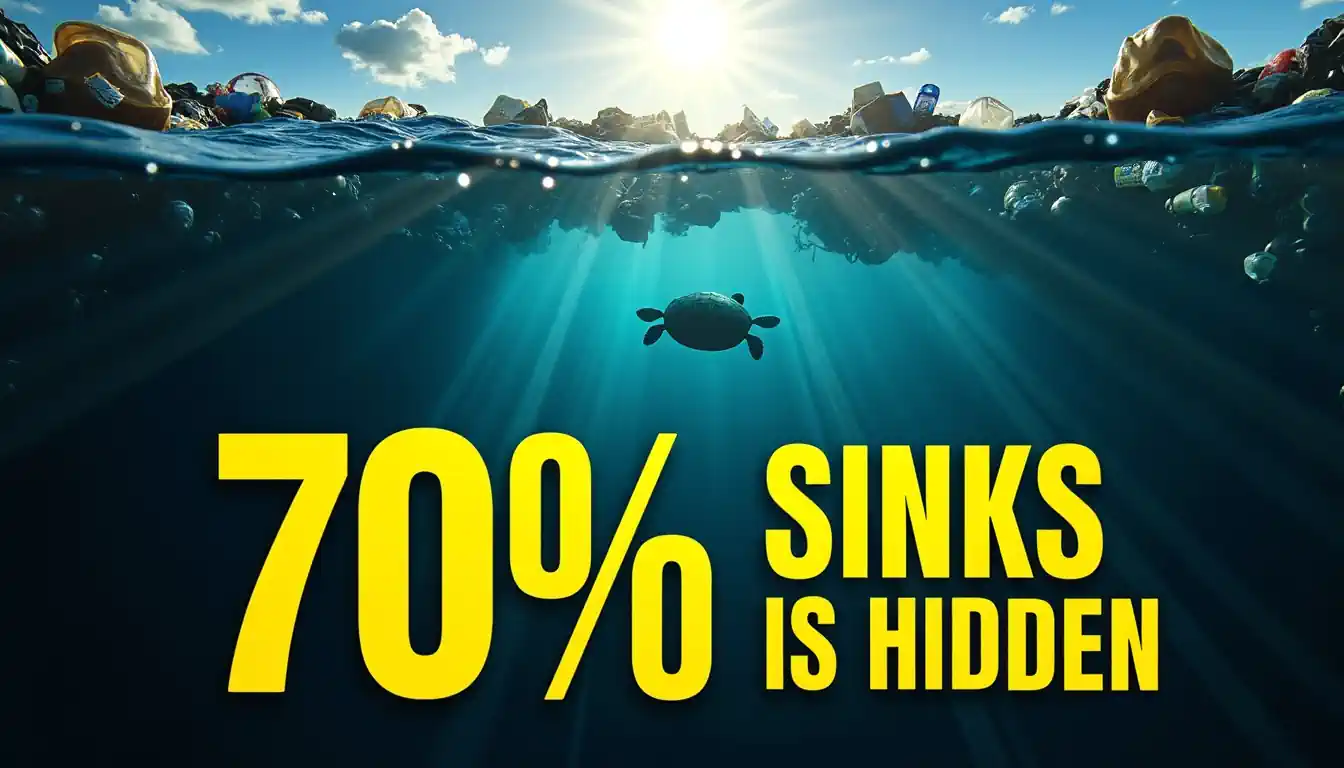
How Garbage Patches are Destroying the Environment
Garbage patches in the ocean are more than just an eyesore. They pose a continuous and serious threat to marine life, the chemistry of the ocean, and even human health. The damage they cause affects everything from the largest marine mammals to the smallest organisms that form the foundation of the ocean food chain.
One of the most damaging types of debris found in ocean garbage patches is fishing gear. This is often referred to as ghost gear, and includes abandoned, lost, or discarded fishing nets and lines that continue to trap and kill marine life long after they’ve been lost at sea. The Ocean Cleanup has discovered that a large portion of the plastic mass within the Great Pacific Garbage Patch consists of ghost gear. Its risk of entanglement is ongoing and indiscriminate, posing a threat to fish, seabirds, sea turtles, and marine mammals.
In addition to entanglement, the chemical aspect of plastic pollution in these patches is becoming more and more concerning. Plastic particles in the ocean behave like sponges for persistent organic pollutants — toxic compounds including PCBs and DDT that do not easily decompose in the environment. As these particles loaded with chemicals move up the food chain, the concentration of toxins can increase at each level, a process known as biomagnification.
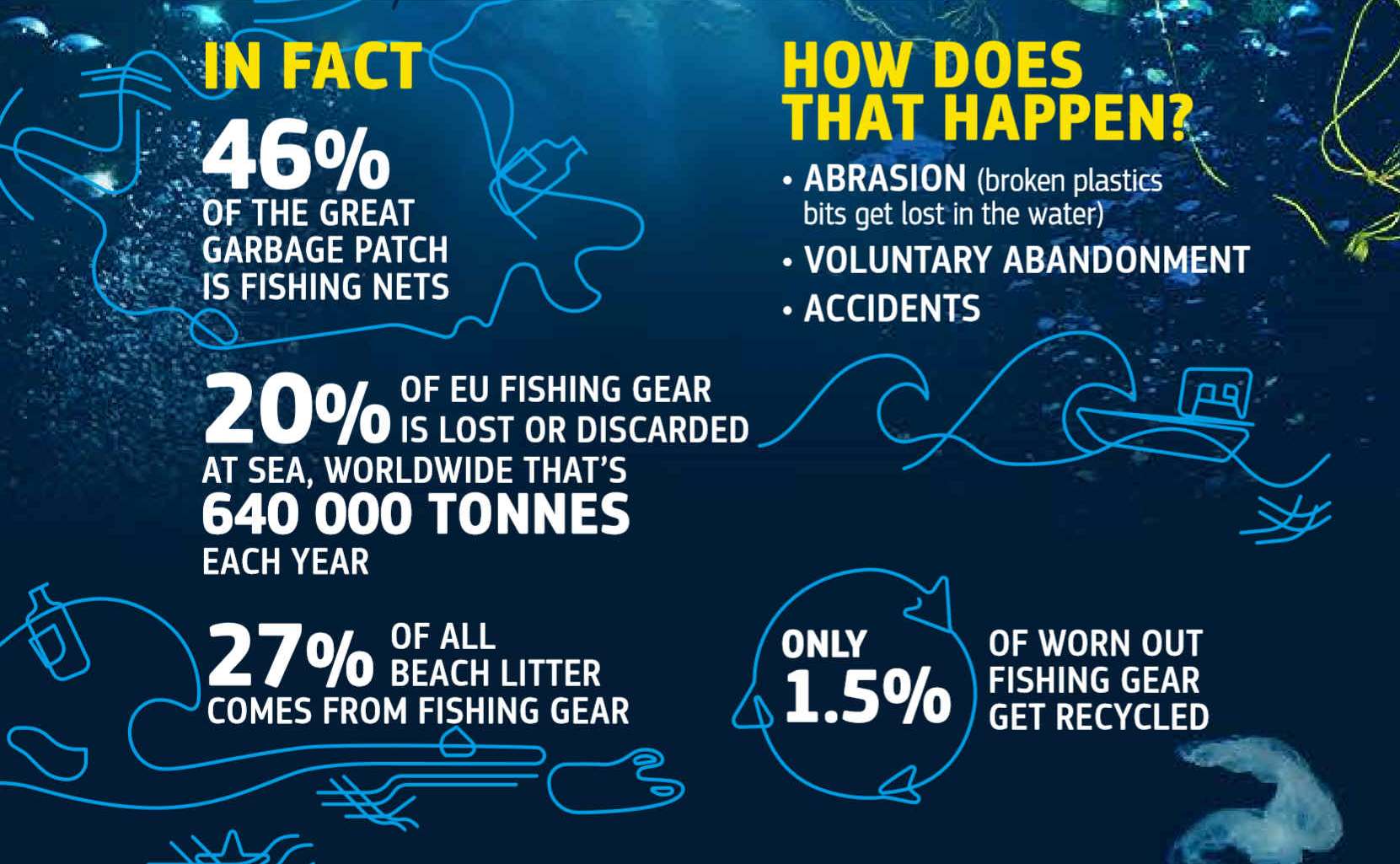
“EU GHOST FISHING NETS GEAR LINES POTS …” from www.oceansplasticleanup.com and used with no modifications.
Understanding the Damage Caused by Garbage Patches:
The damage caused by marine debris in ocean garbage patches is extensive and wide-ranging. It can cause harm at every level, from ghost nets that entangle whales and sea turtles to microplastics that disrupt the feeding behavior of zooplankton. It can also lead to toxic chemical loads entering the seafood that we consume. The damage isn’t just limited to the patches themselves; it extends to ocean ecosystems around the world.
The Effect on Marine Wildlife
More than 800 species of marine wildlife are known to be impacted by plastic pollution in the ocean. Sea turtles often confuse plastic bags with jellyfish and eat them, which can cause internal blockages that are almost always deadly. Seabirds, especially albatrosses in the Pacific, feed plastic pieces to their chicks because they mistake the colourful pieces for food. This behaviour has been observed killing chicks at alarming rates on remote Pacific islands that are thousands of kilometres away from the nearest human settlement.
Ghost gear poses a significant risk to marine mammals, as it can entangle them, restrict their movement, starve them, and even cause them to drown. Whales have been discovered stranded with hundreds of kilograms of plastic in their stomachs. These are not isolated incidents. They are well-documented, recurring patterns observed in all five garbage patch regions and the surrounding ocean areas.
Garbage patches pose a dual threat to coral reef ecosystems in their vicinity. Studies have revealed that the chances of coral disease increase significantly when plastic waste lands on coral. This may be due to the introduction of bacteria into reef systems or the physical damage to coral tissue that creates openings for infection. Considering that coral reefs are home to about 25% of all marine species, the ripple effects of this damage reach far beyond the reefs. Learn more about food waste depackaging and its impact on marine environments.
Microplastics and the Food Chain
Small fish and zooplankton at the bottom of the ocean’s food chain cannot tell the difference between microplastic particles and their normal food. These particles are eaten by these creatures, which not only ingest the plastic but also the toxic chemicals it carries. These creatures are then eaten by larger fish, which are eaten by even larger predators. With each step, the chemical load from the plastic increases. This is how microplastics and their associated pollutants can move from a remote ocean garbage patch to a dinner plate.

“Marine plastic pollution – Wikipedia” from en.wikipedia.org and used with no modifications.
Is It Possible to Clean Up the Garbage Patches?
The task of cleaning up the ocean garbage patches is one of the most technically complex environmental challenges ever faced by mankind. The sheer size of the patches, along with the prevalence of microplastics that are almost impossible to filter out from open water without also taking out marine organisms, means that no current technology can just “suck up” a garbage patch. To make a real difference, we need to tackle the problem from both sides — stopping new plastic from getting into the ocean while also working to remove what is already there.
The Complications of Microplastic Removal
Microplastics pose a unique problem compared to larger debris such as bottles or fishing nets. These tiny particles, often much smaller than 5 millimetres, cannot be filtered out of the open ocean without also removing plankton and larvae that are critical to marine food chains. Any cleanup system that could effectively remove microplastics on a large scale would also remove the very organisms it aims to protect, essentially sterilising the ocean surface. This is not a small technical challenge. It is a fundamental problem that no existing technology has been able to solve. To learn more about these challenges, you can explore the efforts of The Ocean Cleanup.
Another issue is the depth of the ocean. Microplastics don’t just sit on the surface of the water. They are found throughout the entire water column, at the bottom of the ocean, and even within the sediments on the seafloor. A system that only skims the surface of the water would only capture a small portion of the total plastic in any given area. Studies have found microplastics in the deepest parts of the ocean, including the Mariana Trench. This means that the pollution extends to parts of the ocean that are virtually unreachable by any cleanup technology that we have today.
What’s Being Done to Clean Up the Great Pacific Garbage Patch?
The Ocean Cleanup, a nonprofit organisation based in the Netherlands and founded by Boyan Slat, is currently leading the most prominent active cleanup effort targeting an ocean garbage patch. Their System 03 — a large U-shaped barrier roughly 2.4 kilometres wide that is towed by two vessels — is designed to passively capture macro plastic and larger debris from the surface of the Great Pacific Garbage Patch. The plastic collected is brought back to shore, sorted, and recycled into consumer products. The organisation has reported that it has extracted hundreds of thousands of kilograms of plastic from the Pacific in its operational runs.
Yet, The Ocean Cleanup openly admits that their ocean systems alone cannot fix the issue. They pair their offshore extraction with river interception systems, known as Interceptors, which are placed at the mouths of the world’s most polluting rivers to stop plastic before it gets to the ocean. This two-pronged approach mirrors the scientific agreement that cleanup must be coupled with strong prevention measures to have any lasting effect. Without significantly cutting down the amount of new plastic entering the ocean, cleaning up what’s already there is, as researchers have said, like trying to bail out a sinking boat without plugging the hole.
There are more than 5 trillion pieces of plastic in the ocean and it’s increasing
Studies have shown that there are over 5 trillion pieces of plastic floating in the world’s oceans. This includes everything from large pieces of debris to tiny fragments of microplastic, and only accounts for the plastic that is at or near the surface, not what has sunk to the bottom or been eaten by marine life. The actual total amount of plastic in the ocean is likely much higher, possibly by several orders of magnitude.
The most concerning aspect of this figure is its upward trend. Plastic production worldwide has been on the rise almost every decade since the 1950s, and the systems for dealing with plastic waste – especially in rapidly developing economies in Southeast Asia, South Asia, and sub-Saharan Africa – have not been able to keep up. The result is a steadily growing stream of plastic into river systems that lead straight to the ocean. Without significant intervention at both the production and waste management levels, the 5 trillion figure is not a limit. It’s a point on a curve that continues to rise.

“Marine plastic pollution – Wikipedia” from en.wikipedia.org and used with no modifications.
Common Questions
- How many garbage patches exist in the ocean?
- Where can you find the largest ocean garbage patch?
- Is it possible to see the garbage patches from a boat?
- How were the ocean garbage patches created?
- Is anyone currently working to clean up the ocean garbage patches?
How many garbage patches exist in the ocean?
There are 5 garbage patches in the ocean in total. Each one is located within one of the five major subtropical gyres of Earth: the North Pacific, South Pacific, North Atlantic, South Atlantic, and Indian Ocean gyres. The Great Pacific Garbage Patch in the North Pacific is the largest and most researched, but all five patches are verified accumulation zones of marine debris. Learn more about the impact of marine debris through food waste depackaging and its environmental implications.
Where can you find the biggest garbage patch in the ocean?
The Great Pacific Garbage Patch is the biggest garbage patch in the ocean. It’s situated in the North Pacific Gyre, between Hawaii and California. According to research from The Ocean Cleanup, it covers an estimated 1.6 million square kilometers and holds a minimum of 80,000 metric tons of plastic. This makes it the largest collection of marine debris in the world.
Are the garbage patches visible from a boat?
Contrary to popular belief, sailing through a garbage patch does not mean you’ll be sailing through a visible sea of trash. Even in the largest patches, the ocean surface often looks quite normal. The debris is spread out over massive distances and a lot of it is made up of microplastics that are too small to be clearly seen from the deck of a boat.
What Sailors Actually Report:
Researchers and sailors who have traveled through the Great Pacific Garbage Patch frequently describe seeing scattered fragments, occasional larger items like buoys or bottle caps, and stretches of open water that look clean. It’s only when trawl nets are dragged through the water that the true density of microplastic particles becomes apparent. The garbage patch is a scientific reality confirmed by water sampling — not a visual spectacle observable from a boat in the way news coverage sometimes implies.
This disconnect between public perception and physical reality is one of the reasons ocean plastic pollution is sometimes underestimated as a crisis. Because the patches don’t look like what people expect, the urgency can feel abstract. The damage, however, is anything but.

“Garbage patch – Wikipedia” from en.wikipedia.org and used with no modifications.
What led to the formation of the ocean garbage patches?
There are two main forces that lead to the formation of the ocean garbage patches. The first is the natural physics of ocean circulation, and the second is the significant increase in global plastic production over the past 70 years. Ocean gyres, which are large systems of rotating currents, naturally gather floating material towards their centres. Before the era of mass plastic production, this meant organic debris like seaweed and driftwood. As single-use plastics became more and more common from the 1950s and onwards, and as global waste management failed to handle the amount of plastic being thrown away, more and more of that plastic ended up in waterways and eventually the ocean.
Rivers are the main source of ocean plastic. Research has shown that a small number of highly polluted rivers, mostly in Asia and Africa, are responsible for the majority of the plastic that ends up in the ocean each year. Once the plastic is in the ocean, currents carry it to the nearest gyre, where it slowly spirals inward and builds up. This process has been going on for decades, which is why the garbage patches we see today are much larger and denser than those documented in earlier studies.
Are there any ongoing efforts to clean up these ocean garbage patches?
- The Ocean Cleanup is running System 03 in the Great Pacific Garbage Patch, a 2.4-kilometre passive barrier that captures large plastic pieces on the surface during regular extraction runs.
- River Interceptors that The Ocean Cleanup has set up aim to catch plastic at river mouths before it can make it to the ocean, tackling the source of new debris entering marine systems.
- NOAA’s Marine Debris Program provides funding for research, monitoring, and regional cleanup initiatives in U.S. waters and collaborates with international partners on global debris tracking.
- Various NGOs and coastal organisations carry out beach cleanups and near-shore debris removal, which — while not directly targeting the open ocean patches — help to lessen the amount of plastic that can enter gyre systems.
There are active cleanup efforts, but there is one point on which researchers and environmental scientists agree: extraction alone is not the solution. The five garbage patches will keep growing as long as more plastic is dumped into the ocean each year than is taken out. The math is simple. Even the most ambitious cleanup operations currently in progress remove only a fraction of the plastic that enters the ocean each year from combined land-based and maritime sources.
What’s encouraging for researchers is the increasing focus on policies to reduce plastic production. International negotiations on a Global Plastics Treaty — under the UN Environment Programme — are ongoing. The aim is to create binding commitments to reduce plastic production, improve waste management infrastructure worldwide (in particular to halt microplastic creation during municipal recycling, by using low-impact depackaging and separation machinery), and hold producers responsible for the lifecycle of their products. If successful, such a treaty would tackle the root cause in a way that no cleanup technology on the open ocean ever could.
While there are indeed efforts to clean up the garbage patches, they are not enough to solve the problem. The real solution lies in preventing the garbage from reaching the ocean in the first place. The best thing we can do in the next ten years is not to send more cleanup ships to the Pacific, but to create an international agreement that significantly reduces plastic production and responsibly manages its disposal, such as through incinerating waste.
The presence of five garbage patches in our oceans sends a clear message: the ocean doesn’t forget what we dump into it. Every piece of plastic that finds its way into a waterway could travel thousands of kilometres and end up in the heart of a gyre. There, it will stay, breaking down into ever-smaller pieces, for hundreds of years. The patches are not a problem for the future. They are a present and growing crisis that calls for action on all fronts, from the choices we make as consumers to the policies we enact on a global scale.

Food Waste Separator: Definition, Uses & Benefits
A food waste separator is a mechanical device that separates organic food waste from non-organic waste. It reduces landfill contributions and greenhouse gas emissions by up to 80%. Discover how this transformative technology promotes sustainability and reuses organic waste in resourceful ways, creating a circular economy…

Optimizing Food Waste for Enhanced Biogas Production in Anaerobic Digesters
Mixing food waste with cattle manure can boost biogas yield significantly. Optimizing solid concentrations and pH levels enhances production. Pre-treatment methods like size reduction and heat treatment speed up digestion. Leveraging these strategies, biogas from food waste could satisfy up to 57% of urban energy demands…
How to Reduce Food Waste Globally
Reducing global food waste involves prevention, redistribution, and recycling. Strategies include meal planning, better harvesting, and donating leftovers. Governments must support policies and raise awareness. With one-third of food wasted annually, the economic loss hits $940 billion. Simple household actions can make a significant impact on this challenge…

The Solar Biogas Hybrid System: Incorporating Solar Energy Integration with Anaerobic Digestion
Integrating solar energy with anaerobic digestion enhances biogas production by using solar thermal collectors and photovoltaic panels. This synergy not only decreases biogas dependency by 65% but also produces energy consistently, proving especially advantageous in remote locations with competitive energy costs of $0.045/kWh…